Flat roof repair is the most Newark of roofing jobs. Walk down a block of brick rowhouses or a row of walk-ups and many of the roofs you cannot see from the street are flat or nearly flat, tucked behind a parapet wall. This page explains what those roofs are made of, where they fail, and what a repair involves, so you can talk to a roofer knowing what to ask.
Roofer Newark is an independent referral service, not a roofing company. The site’s operator receives each call and form request and passes it to an independent local roofer who can contact you about the job. Any quote, and any work, comes from that roofer.
Why flat roofs are everywhere in Newark
Flat and low-slope roofs are common on city rowhouses and multi-family buildings. In the East Ward, which includes the Ironbound, the housing is mostly large apartment buildings and rowhouses. A flat roof is efficient on an attached building: it sits between shared walls, it is hidden behind the parapet, and it gives room for vents, hatches and equipment.
The trade-off is drainage. A pitched roof sheds water quickly. A flat roof has a slight slope toward a drain or a scupper in the parapet, and it relies on that path staying clear. Newark gets an average of 46.6 inches of rain and melted snow a year at the airport station, so the path gets a lot of use.
What your flat roof is covered with
Knowing the covering helps you understand the repair. If you can get onto the roof safely through a hatch, or see it from a neighbor’s window, a photo is enough for a roofer to tell.
| Covering | What it looks like | How repairs are usually made |
|---|---|---|
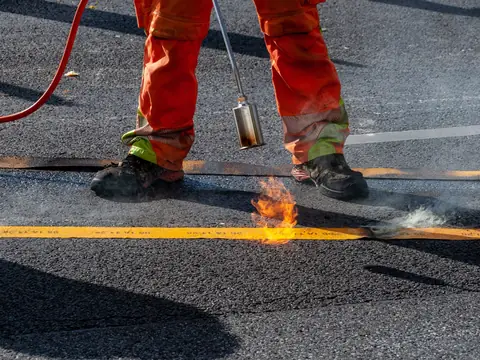
| Modified bitumen | Rolled sheets, often with a granule surface, overlapping at seams; applied by torch or adhesive | Patches of the same material over cleaned, primed areas; seams re-sealed |
| EPDM (rubber) | Large dark rubber sheets with glued or taped seams | Rubber patches and seam tape bonded with the right primer |
| TPO | Light-colored single-ply sheets with heat-welded seams | Patches of TPO heat-welded over the damage |
| Built-up roofing | Layers of felt and asphalt, often topped with gravel | Damaged layers cut out and rebuilt, or the area covered with a compatible patch |
| Roof coatings | A painted-on layer over an older roof, often white or silver | Spot repairs with compatible coating; the base roof has to be sound first |
Patching with a material that does not suit the covering can cause trouble. Ask the roofer what the roof is covered with before they start, and what they plan to put on it.

The problems that bring the calls
Ponding water
Water left standing on a flat roof well after the rain has stopped is called ponding. It usually means a low spot in the deck or a blocked drain. Standing water keeps the covering wet, adds weight and finds any weakness in a seam. The fix depends on the cause: clearing the drain, building up the low spot, or adding a drain or scupper.
Blisters
A blister is a raised bubble in the covering where air or moisture is trapped between layers. Summer heat can make it grow: the July average high at Newark Liberty is 86.9 degrees, and a dark flat roof in full sun runs hotter than the air. A blister that has not cracked may be left and watched; one that has cracked or is spreading is cut out and patched.
Open seams
Every flat roof made of sheets has seams. Heat, cold and movement work at them. In winter the January average high is 40 degrees, and the covering shrinks and swells with each freeze and thaw. An open seam lets water run under the sheet, where it can travel a long way before it drips through a ceiling.
Where the roof meets the parapet
Where the flat roof turns up the parapet wall, the covering is flashed up the brick and capped by coping at the top. Cracked coping, loose flashing or tired mortar lets water into the wall itself. In a rowhouse, that wall is often shared, so a parapet leak can show up as damp plaster on a top-floor wall rather than a ceiling stain.
Drains, scuppers and leaders
Leaves, grit and the occasional ball or bottle end up in roof drains and scuppers. When they block, the water has nowhere to go but back across the roof and over the parapet, or into the building. Clearing them is a small job that heads off bigger trouble, and they are worth checking on every visit.
Penetrations
Vents, pipes, hatches, skylights, chimneys and equipment curbs all pass through the covering. Each is a joint that has to be flashed and sealed, and each is a common leak point.


Water standing on the roof or coming through the top floor? Call or send the form and a Newark roofer can contact you.
Repair, re-cover or replace?
A flat roof can usually be repaired where the trouble is local: one blister, one seam, one parapet, one drain. When problems turn up across the surface, the conversation changes. A roofer may talk about a coating over a sound older roof, a new covering over the old one where that is allowed and the old one is dry, or a tear-off down to the deck. Which is right depends on what is under the covering. Ask the roofer whether they found wet insulation or soft deck, and how they know.
There is no fixed age at which a flat roof has to go, and this site does not quote lifespans or prices. If replacement comes up, the roof replacement in Newark page explains what to get in writing.
Permits and attached buildings
New Jersey’s ordinary-maintenance rule lets an owner repair or replace the existing roof covering on a detached one- or two-family house without a permit. Many flat roofs in Newark sit on attached rowhouses or larger buildings, which that roof item does not cover. For an attached rowhouse, a multi-family building, or any structural work such as replacing deck boards or joists, ask the City of Newark’s construction office whether a permit is needed before work starts. The Newark roofing permit guide goes through the rule.
Working on a shared roof line
On a row of attached houses, one roof often runs into the next with nothing between them but a low wall or a line of flashing. That raises practical questions worth asking before work starts:
- Where exactly does your roof end and the neighbor’s begin, and how will the roofer tie the new work into theirs?
- Is the leak coming from your side or from the joint between the roofs?
- How will the roofer reach the roof: through your hatch, by ladder from the street or yard, or from a neighbor’s building?
- Where will debris go, and who cleans the street, yard or neighbor’s roof afterward?
A word with the neighbor before work starts saves trouble later, especially if the repair has to cross the line.
What to tell the roofer about a flat roof
- Where the water shows inside: a ceiling, a top-floor wall, or around a skylight or hatch
- Whether it leaks in every rain, in wind-driven rain, or when snow melts
- Whether water stands on the roof after rain, and where
- How old the covering is, if you know, and what it is made of
- Whether there is a roof hatch, and whether equipment such as condensers sits on the roof
- Whether the roof joins a neighbor’s roof with no wall between them
Keeping a flat roof healthy
- Keep drains, scuppers and gutters clear, especially after leaves come down
- Look at the roof after heavy storms, from the hatch if you can do it safely
- Note any water still standing well after rain and tell the roofer
- Keep foot traffic, grills and furniture off the covering unless it is made for it
- Have new equipment, satellite dishes or vents flashed by a roofer, not just screwed down
Before you hire anyone, check that the contractor is registered with the New Jersey Division of Consumer Affairs and read the checklist on roofing contractors in Newark, NJ. For the general picture of leaks on any kind of roof, see roof repair in Newark.
Questions people ask
What are the downsides of a flat roof?
Water drains slowly, so blocked drains and low spots leave it standing, and seams, blisters and parapet flashing need watching. Kept clear and repaired early, a flat roof works well on an attached building.
What is my flat roof made of?
Usually modified bitumen, EPDM rubber, TPO, built-up roofing, or a coating over one of them. A clear photo of the surface and a seam lets a roofer tell.
Can a flat roof be patched?
Yes, when the damage is local, using the same type of material as the roof. Widespread blisters, cracks or wet insulation call for a larger job.
Why is water pooling on my flat roof?
Most often a blocked drain or scupper, or a low spot in the deck. Clearing the drain is the first step; a low spot needs a roofer to build it up or add drainage.
Does a flat roof repair on a rowhouse need a permit?
The New Jersey roof-covering exemption names detached one- and two-family houses. For an attached rowhouse or larger building, ask the City of Newark’s construction office before work starts.
Can a new roof go over the old flat roof?
Sometimes, if the old covering is dry and sound and the rules allow it. Ask the roofer what they found under the surface and why they recommend going over or tearing off.
Get a Newark roofer
Get a Newark roofer on the roof
Send the details and an independent local roofer can contact you.
