A roof replacement in Newark is a bigger decision than a repair, and it usually arrives after a run of repairs that no longer hold. This page covers the signs that a roof has reached the end, the materials that suit Newark’s houses and buildings, the permit rule, and what the contract should say. It prints no prices, because the price depends on the building, the roof and the roofer, and a roofer gives it in writing.
Roofer Newark is an independent referral service, not a roofing company. The site’s operator receives each call and form request and passes it to an independent local roofer who can contact you about the job. Any quote, and any work, comes from that roofer.
Signs a roof is done
No single sign settles it, and there is no fixed age at which every roof must go. But some patterns point clearly toward replacement rather than another patch:
- Leaks in several places that are not connected to each other
- New leaks soon after each repair
- On a shingle roof: curling, cracking or bald shingles across every slope, and granules collecting in the gutters
- On a flat roof: blisters, cracks and open seams across the surface, not just in one spot
- Soft or springy areas underfoot, which suggest wet insulation or rotten deck
- Daylight through the roof boards in the attic, or sagging between rafters
Newark weather is hard on a roof. The airport station averages 46.6 inches of rain and melted snow a year and 31.5 inches of snow, and the July average high is 86.9 degrees. A roof that has been through many rounds of freeze, thaw and summer sun shows it at the seams, the flashing and the surface.

Repair one more time, or replace?
A fair way to put the question to a roofer: is the trouble in one part of the roof, or in the whole covering? If it is one part, a repair may be the right call even on an older roof. If it is the whole covering, money spent on repairs may be better spent on the new roof. Ask the roofer to show you, in photos, what they see. On a job this size, having a second roofer look is sensible. The roof repair in Newark page covers the repair side of the decision.
Materials for Newark roofs
What goes on depends mostly on the shape of the roof. Newark has both: flat and low-slope roofs on rowhouses, walk-ups and multi-family buildings, and pitched roofs on two-family homes and detached houses.
Pitched roofs
| Material | What it is | Things to ask |
|---|---|---|
| Asphalt shingles | The most familiar pitched-roof covering: overlapping shingles over underlayment | Which product line, what underlayment, how valleys and edges are finished |
| Slate | Natural stone pieces hung on the roof; found on some older houses | Whether the slate can be repaired instead, and whether replacement keeps slate |
Flat and low-slope roofs
| Material | What it is | Things to ask |
|---|---|---|
| Modified bitumen | Rolled asphalt-based sheets, torch-applied or adhered, often in layers | How many layers, how seams are sealed, whether torch work suits the building |
| EPDM | A rubber membrane in large sheets with glued or taped seams | How seams and the parapet are flashed |
| TPO | A light-colored single-ply sheet with heat-welded seams | How the sheet is attached and the seams welded |
| Built-up roofing | Layers of felt and asphalt, often under gravel | Whether it will be rebuilt or replaced with a sheet system |
| Coatings | A layer applied over a sound older roof | Whether the base roof is dry and sound enough to coat |
The flat roof repair page describes how each of these flat-roof coverings fails, which is worth knowing before you pick one.
Keeping a slate roof
If the house has slate, ask first whether it can be repaired rather than replaced. Slate is fixed piece by piece, and the trouble on an older slate roof is often the flashing in the valleys and at the chimney rather than the stone. A roofer who works with slate can tell you whether the slates themselves are sound. If replacement does make sense, ask whether the new roof keeps slate or changes to another material, and check first with the city if the house is in a historic district.


Think the roof is done? Call or send the form and an independent Newark roofer can contact you to look at it.
Permits: detached or attached makes the difference
New Jersey’s Uniform Construction Code lists the repair or replacement of existing roof covering on detached one- and two-family dwellings as ordinary maintenance, which can be done without a permit application or notice to the construction official. A new covering on a detached two-family house fits that item, whichever ward the house is in.
The roof item does not name attached homes, larger buildings, or structural work. Ordinary maintenance never includes work affecting structural or fire safety, or removing or cutting a structural beam or bearing support. So for an attached rowhouse, a multi-family building, or a job that replaces rafters, joists or the roof deck, ask the City of Newark’s construction office whether a permit is needed before work starts. If the building is in a historic district, such as James Street Commons, ask the city before changing the roofing material or anything visible. The Newark roofing permit guide explains each case.
Tear-off or a layer over the old roof
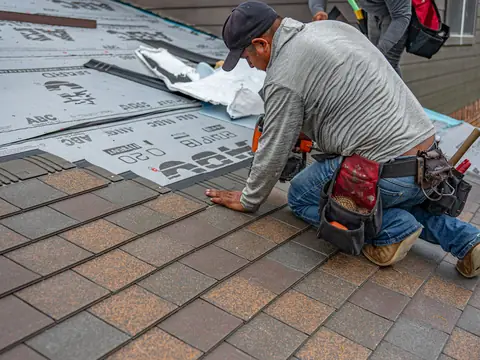
A tear-off strips the old covering to the deck. It costs more labor, but it lets the roofer find and replace rotten boards and start the new roof on a sound base. An overlay puts the new covering over the old one where that is allowed and the old roof is dry and flat. Ask which the roofer proposes and why, and what happens, and at what price, if they find damaged deck once the old roof is off.
What the contract should say
New Jersey requires a contract in writing for any home improvement job of $500 or more, and it must show the contractor’s legal name, business address and registration number, a start date, a completion date, a description of the work and the total price. Get a replacement in writing whatever it costs. A good description also names:
- Whether the old roof is torn off or covered over, and how many layers are removed
- The new covering by product and color, and the underlayment
- New flashing at chimneys, walls, parapets and vents
- Gutters, leaders, drains and scuppers: what is replaced or reused
- How rotten deck is handled and priced
- Protection of the house, yard and neighbors’ roofs, and debris removal
- Who applies for any permit
Check the contractor’s registration with the New Jersey Division of Consumer Affairs, get a copy of the liability insurance policy and confirm it with the insurer, and agree a payment schedule: it is customary not to pay for the entire project in advance. Once signed, the contract can still be canceled for any reason until midnight of the third business day after your copy reaches you. The roofing contractors in Newark, NJ page lays it out as a checklist.
What does a roof replacement cost in Newark?
This site prints no prices or ranges. What moves the price is easy to list, though, and knowing it helps you read a quote: the size and shape of the roof; the material; how many old layers come off; how much deck needs replacing; how much flashing, gutter and drain work is included; how hard the roof is to reach on a tight block; and whether a permit is involved. Two quotes that differ a lot usually differ on one of these, so compare the written descriptions line by line.
Living through the job
Expect noise, a dumpster or a debris chute, and a crew on and off the roof. Move cars away from the drop zone, take fragile things off top-floor walls and shelves, and keep children and pets clear of the work area. Ask the roofer how the roof will be kept watertight overnight and if rain comes partway through. At the end, walk the job or look at the photos, check it against the contract, and make the final payment then. What a full job looks like day to day is on the roofing company in Newark page.
Questions people ask
How do I know if my roof needs replacing?
Leaks in several unrelated places, new leaks after each repair, worn shingles across every slope, or blisters and soft spots across a flat roof all point toward replacement. A roofer can show you in photos.
Do I need a permit to replace a roof in Newark?
Replacing the roof covering on a detached one- or two-family house is ordinary maintenance under the New Jersey code. For an attached rowhouse, a larger building or structural work, ask the City of Newark’s construction office first.
How much does a new roof cost in Newark?
This site prints no prices. The cost depends on the roof’s size and shape, the material, the layers removed, deck repairs, flashing and access. The roofer gives the total in the written contract.
Can new roofing be laid over the existing roof?
Sometimes, where that is allowed and the old covering is dry and sound. A tear-off lets the roofer check and repair the deck. Ask which is proposed and why.
What material should I use?
Pitched roofs usually take asphalt shingles, and some older houses have slate. Flat roofs take modified bitumen, EPDM, TPO, built-up roofing or a coating. Ask the roofer why they recommend one for your building.
Can I cancel a roof replacement contract?
In New Jersey you may cancel a signed home improvement contract for any reason before midnight of the third business day after you receive a copy.
Get a Newark roofer
Get a Newark roofer on the roof
Send the details and an independent local roofer can contact you.
