Roof repair in Newark usually starts with something small: a brown ring on a top-floor ceiling, a drip by the chimney after a hard rain, a few shingles on the sidewalk after a windy night. This page explains where roofs in this city tend to leak, what a roofer checks on a repair visit, and how to tell a repair from a roof that needs replacing.
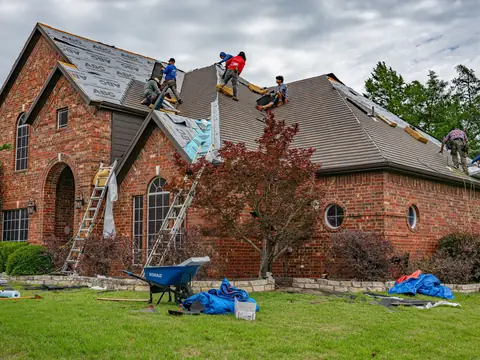
Roofer Newark is an independent referral service, not a roofing company. The site’s operator receives each call and form request and passes it to an independent local roofer who can contact you about the job. Any quote, and any work, comes from that roofer.
Why Newark roofs need repairs
The long-term weather station at Newark Liberty International Airport averages 46.6 inches of rain and melted snow a year and 31.5 inches of snow, in the federal normals for 1991 to 2020. Rain and snow arrive in every season, and in the colder months it freezes and thaws over and over. Every pass of that cycle pries a little at the joints of a roof: where flashing meets brick, where two sheets of membrane overlap, where a nail holds a shingle.
Then there is the building itself. A lot of Newark’s housing is attached: rowhouses and walk-ups that share walls and often have flat or low-slope roofs behind a parapet. Others are two-family homes and detached houses with pitched roofs of asphalt shingle or, on some older houses, slate. A flat roof and a pitched roof leak in different places, so the first thing a roofer wants to know is which kind you have.
Where leaks start
Water rarely comes through the middle of a sound roof. It finds the joints, the edges and the places where something passes through the covering. These are the spots a roofer looks at first:
| Where | What goes wrong | What you might notice |
|---|---|---|
| Chimney flashing | Metal or membrane pulls away from the brick, or the mortar behind it cracks | A stain on the ceiling or wall next to the chimney |
| Parapet walls | Flashing and coping at the top of the wall open up and let water into the wall | Damp plaster on a top-floor wall, often the party wall |
| Vents and pipes | The collar around a plumbing vent or exhaust dries out and splits | A small ring on the ceiling under the vent |
| Skylights and hatches | The curb flashing or sealant fails | Drips around the skylight frame in heavy rain |
| Flat-roof seams | Overlaps between membrane sheets open, or blisters crack | Leaks that move around and show up far from the cause |
| Drains, scuppers and gutters | Leaves and debris block them and water backs up | Standing water on the roof, overflow down the wall |
| Shingles and slate | Pieces lift, crack, slip or blow off | Shingles or slate pieces on the ground, bare spots seen from the street |
In winter, ice in the gutters adds one more: meltwater dams behind the ice at the roof edge and runs back under the shingles. The leak looks like it comes from the wall or the top of a window, not the roof.

The day the ceiling starts to drip
Water coming in right now?
Stay off the roof while it is wet or icy. Put a bucket under the drip and move furniture, rugs and electronics away from it. Take photos of the ceiling, the wall and anything damaged before you clean up, so you have a record for your insurer. Then call or send the form. The roof leak repair page goes step by step.
Whether an insurance policy covers any of the damage is the insurer’s decision, so read your policy, keep your photos, and ask the roofer for a written description of what they found.
Leak, stain or missing shingles? Call or send the form and a Newark roofer can contact you about the repair.
What a repair visit looks at
A good repair visit follows the water. The roofer starts inside, where the stain or drip is, and then goes up to find where the water actually enters, which may not be right above the stain. On a flat roof, water can run along the deck under the membrane before it finds a way down; on a pitched roof, it can run down a rafter. Expect the roofer to look at:
- The ceiling or wall where water shows, and the attic or roof hatch if there is one
- Every penetration near that spot: chimney, vents, skylight, hatch, antenna mounts
- The flashing at walls, parapets and roof edges
- Seams, blisters and soft spots on a flat roof, and any water left standing after rain
- Drains, scuppers, gutters and leaders, and where they send the water
- On a pitched roof, the shingles or slate around the leak and the valleys where two slopes meet
At the end, ask for the findings in writing: what is wrong, what the roofer proposes to do, and what is outside the job. If the repair is a small one, the scope may be a few lines. If the work reaches $500 or more, New Jersey requires a written contract with the contractor’s legal name, business address and registration number, the start and completion dates, a description of the work and the total price.


Repairs by roof type
Flat and low-slope roofs
Rowhouses, walk-ups and many multi-family buildings in Newark have flat roofs covered with modified bitumen, EPDM rubber, TPO, built-up roofing or a coating. Repairs here are mostly about seams, blisters, flashing at the parapet and keeping drains clear. A small open seam or a single blister is usually patched with the same kind of material. Wide areas of cracking or soft deck point toward a larger job. The flat roof repair page covers each membrane.
Asphalt shingle roofs
On a pitched roof, single missing or torn shingles can be replaced, and the flashing around a vent or chimney can be redone without touching the rest. Matching new shingles to old ones is not always exact, so ask to see a sample if the patch will show from the street.
Slate roofs
Slate is repaired piece by piece: a cracked or slipped slate is taken out and a new one slid into place. Walking on slate can break it, so this is work for a roofer who knows slate. Corroded flashing in the valleys and at the chimney is a common cause of leaks on slate roofs.
Gutters, leaders and flashing
Sometimes the roof is fine and the water handling is the problem: a gutter pulled loose, a leader that empties against the foundation, a scupper blocked at the parapet. The gutters and flashing page explains those jobs.
When a repair is no longer enough
There is no rule of thumb in years for when to stop repairing, and this site does not quote one. The question is whether the trouble is in one place or everywhere.
| Points toward a repair | Points toward replacement |
|---|---|
| One leak with one clear cause | Leaks in several unrelated places |
| Damage limited to one slope or one section | Shingles curling or shedding granules across every slope |
| Flashing failed at a chimney, vent or wall | Blisters, cracks and soft spots across a flat roof |
| The rest of the covering is sound | The deck under the covering is soft or rotten |
If the roofer recommends replacement, ask them to show you why, in photos if you cannot get up there. On a large job, a second opinion is reasonable. The roof replacement page explains materials, the permit question and what to get in writing.
Permits for a roof repair
Under New Jersey’s Uniform Construction Code, repairing or replacing the existing roof covering on a detached one- or two-family house is ordinary maintenance: no permit application, no notice to the construction official. For an attached rowhouse, a larger building, or any work on the structure, such as rafters or the roof deck, ask the City of Newark’s construction office whether a permit is needed before work starts. The Newark roofing permit guide covers the details.
Before you agree to a repair
- Check that the contractor is registered with the New Jersey Division of Consumer Affairs
- Ask for a copy of the contractor’s commercial general liability insurance policy and confirm it with the insurer
- Get the work, the price and the dates in writing, and keep a copy
- Do not pay the whole job in advance
- Remember you may cancel a signed contract before midnight of the third business day after you receive your copy
The page on roofing contractors in Newark, NJ turns these into a checklist, and the article on checking a New Jersey roofer explains how to look up a registration.
Ready to have someone look at it? Call or send the form and an independent Newark roofer can contact you.
Questions people ask
Can you repair just part of a roof?
Yes, in many cases. A leak at a chimney, a vent or one seam is usually repaired where it is. When the covering has worn out across the whole roof, a roofer may recommend replacement instead.
Why does my roof leak far from the stain?
Water runs along the deck, a rafter or under a flat-roof membrane before it finds a way down. The roofer traces it back from the stain to where it gets in.
Do I need a permit for a roof repair in Newark?
Repairing the roof covering on a detached one- or two-family house is ordinary maintenance under the New Jersey code. For a rowhouse, a bigger building or structural work, ask the City of Newark’s construction office.
Does a roofer have to be registered in New Jersey?
Yes. Home improvement contractors must register with the New Jersey Division of Consumer Affairs, and you can check a registration at NJConsumerAffairs.gov.
How much does roof repair cost in Newark?
This site prints no prices. The cost depends on the roof type, what failed, how easy the roof is to reach and how much needs replacing. The roofer gives the price in writing.
Should I go on the roof myself?
Keep off the roof while it is wet or icy. Look from the ground or a window, take photos, and leave the climbing to the roofer.
Get a Newark roofer
Get a Newark roofer on the roof
Send the details and an independent local roofer can contact you.
