A roof leak rarely picks a good moment. It shows up as a drip in the middle of a storm, a brown ring on the ceiling of the top-floor bedroom, or a wet patch of plaster on the party wall. This page is for that day: what to do first, what to tell a roofer, and what the repair usually involves on Newark’s flat and pitched roofs.
Roofer Newark is an independent referral service, not a roofing company. The site’s operator receives each call and form request and passes it to an independent local roofer who can contact you about the job. Any quote, and any work, comes from that roofer.
First steps
- Stay off the roof. A wet or icy roof is no place to be, and a flat roof in the dark hides holes, hatches and edges.
- Catch the water. Put a bucket or a pot under the drip, with a towel inside to stop splashing.
- Move things. Shift furniture, rugs, electronics and anything valuable away from the wet area, or cover them with plastic.
- Take photos. Photograph the ceiling, the walls, the floor and anything damaged before you clean up, so you have a record for your insurer.
- Then call or send the form, and describe what you are seeing.
Insurance and your photos
Whether a policy covers any of the damage is the insurer’s decision. Keep your photos, keep any damaged items until the insurer says otherwise, and ask the roofer for a written description of what caused the leak.

Why the stain is not where the leak is
Water that gets through a roof covering does not drop straight down. On a pitched roof it runs along the underlayment or down a rafter until it finds a gap. On a flat roof it can travel under the membrane across the deck before it finds a seam in the boards. A stain in the middle of a room may start at a chimney some distance away. That is why a good roofer starts inside, at the stain, and works back to the source.
Where Newark leaks usually start
| Where the water shows | Where it often gets in |
|---|---|
| Ceiling next to a chimney | Chimney flashing, cracked mortar, or the chimney cap |
| Top-floor wall, often the party wall | Parapet flashing and coping on a flat roof |
| A small ring under a vent | The collar around a plumbing vent or exhaust |
| Around a skylight or roof hatch | The curb flashing and sealant |
| Middle of a top-floor ceiling | An open seam or cracked blister on a flat roof, or water standing over a low spot |
| Top of a window or an outside wall | A gutter or scupper overflowing, or ice in the gutter backing meltwater under the roof edge |
Leaks that come with ice and snow
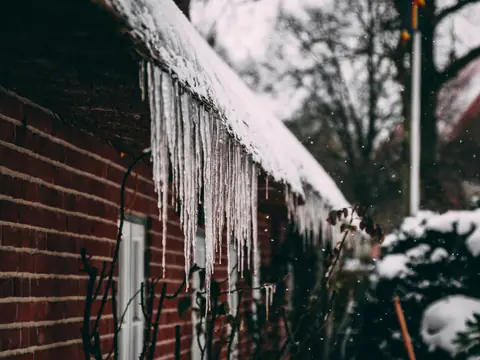
Newark Liberty averages 31.5 inches of snow a year, with about nine inches in January and ten in February in the 1991 to 2020 normals. When snow on the roof melts by day and freezes again at night, ice builds in gutters and at the roof edge. Meltwater dams behind it and backs up under the shingles. These leaks often show on the wall below the roof line or at the top of a window, and they can stop as soon as it warms up, which makes them easy to forget until next time. The article on ice, snow and roof leaks goes into more detail.
Water coming through? Call or send the form and an independent Newark roofer can contact you about the leak.
What to tell the roofer
- Where the water shows, on which floor, and since when
- Whether it leaks in every rain or just with wind from one side or with melting snow
- Whether the roof is flat or pitched, and what it is covered with if you know
- Rowhouse, two-family, detached house or apartment building
- How to reach the roof: a hatch, attic access, or a ladder from the street or yard
- Photos of the stain and, if safe from a window, of the roof
What the repair usually involves
Most leaks have one cause and one repair: new or resealed flashing at a chimney or wall, a new vent collar, a patch over an open seam or a cracked blister, replaced shingles or slates, or a cleared drain or gutter. If the roofer finds wet insulation or soft deck, the job grows, and if leaks keep turning up in different places, the roofer may talk about replacing the covering. The roof repair in Newark page covers repairs by roof type, and the flat roof repair page covers flat roofs in depth.


After the repair
Let the ceiling dry out before it is painted or patched; ask the roofer or a painter how long to wait. Watch the spot in the next few storms. If the roofer’s work costs $500 or more, New Jersey requires a written contract, and either way, keep the paperwork that says what was done. Before anyone starts, check the contractor’s registration with the New Jersey Division of Consumer Affairs.
Questions people ask
What should I do first when my roof leaks?
Stay off the roof, catch the water, move belongings away, take photos for your insurer, and then call or send the form.
How do you find where a roof is leaking?
A roofer starts at the stain inside and traces the water back, checking flashing, vents, seams and drains near it. Water often travels before it drips.
Why does my roof leak when snow melts?
Ice in the gutters and at the roof edge can dam meltwater and push it back under the shingles. Once the ice clears, the leak often stops.
Will insurance pay for my roof leak?
That is the insurer’s decision. Keep photos of the damage and ask the roofer for a written description of the cause to share with the insurer.
Get a Newark roofer
Get a Newark roofer on the roof
Send the details and an independent local roofer can contact you.
