Gutter repair in Newark and flashing work belong on the same page, because they do the same job from two sides: flashing keeps water out of the joints in a roof, and gutters, leaders and scuppers carry it away once it lands. When either fails, the result looks like a roof leak, even when the roof covering itself is fine.
Roofer Newark is an independent referral service, not a roofing company. The site’s operator receives each call and form request and passes it to an independent local roofer who can contact you about the job. Any quote, and any work, comes from that roofer.
Gutters and leaders
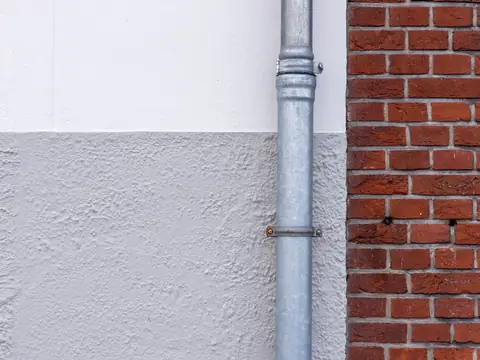
A gutter runs along the edge of a pitched roof and collects the water that runs off it. A leader, which many people call a downspout, carries that water down to the ground or a drain. In a city that averages 46.6 inches of rain and melted snow a year at the airport station, that is a lot of water to move.
Most gutter trouble comes from a few causes:
- Leaves, grit and roof granules clogging the gutter, so water spills over the edge
- Gutters pulling away from the fascia, or sagging so water collects in one spot
- Joints and end caps leaking
- Leaders that are blocked, disconnected or empty right against the foundation
- Ice building in the gutter in cold weather and backing meltwater under the roof edge
Water that overflows a gutter runs down the wall, soaks the brick and mortar, and can find its way inside at the top of a window or into a basement. Clearing and repairing gutters is often the simplest fix for what looks like a bigger problem.
No permit for gutters and leaders
New Jersey’s Uniform Construction Code lists the repair, replacement or installation of exterior gutters and leaders as ordinary maintenance, which can be done without a permit application or notice to the construction official.

Scuppers and drains on flat roofs
Many rowhouses and walk-ups have no gutter along the front at all. Their flat roofs slope gently toward a drain in the roof or a scupper, an opening through the parapet wall that lets water spill into a leader box and down. When a scupper or drain blocks, water stands on the roof and finds any weak seam. Keeping them clear is one of the most useful things an owner of a flat roof can do. The flat roof repair page covers ponding and drains in more detail.
A short list for owners
- Look at gutters and scuppers after the leaves come down, and clear them if you can do it safely from the ground or a hatch
- Check that every leader is connected at the top and open at the bottom
- Make sure leaders empty away from the foundation, not against it
- After a heavy storm, look for water running down the outside of the brick, a sign of overflow
- Note stains at the top of windows or on a top-floor wall and tell the roofer where they are
Flashing
Flashing is the metal or membrane that seals the joint wherever a roof meets something else: a chimney, a wall, a parapet, a skylight, a vent pipe, or another section of roof. It is a common place for leaks to begin, because those joints move as the building heats and cools and as each freeze and thaw works at them.
| Where | What fails | What a roofer usually does |
|---|---|---|
| Chimney | Flashing pulls away from the brick; mortar cracks behind it | New step and counter flashing, repointing where the flashing is set |
| Parapet wall | Membrane flashing up the wall loosens; coping on top cracks | Re-flashing the wall and resetting or replacing the coping |
| Walls beside a lower roof | Flashing where a roof meets a taller wall comes loose | New wall flashing tucked into the masonry or behind siding |
| Skylights and hatches | Curb flashing and sealant fail | Re-flashing the curb or replacing the unit’s flashing kit |
| Vents and pipes | Rubber collars dry out and split | A new collar or boot |
| Valleys | Metal in the valley between two slopes corrodes or splits | New valley flashing, often with shingles or slate around it reset |


Overflowing gutters or a leak by the chimney? Call or send the form and a Newark roofer can contact you.
Ice in the gutters
Newark Liberty averages 31.5 inches of snow a year in the 1991 to 2020 normals. When snow melts by day and refreezes at night, gutters fill with ice, and the meltwater behind it has nowhere to go but back under the roof edge. Clear gutters before cold weather, keep leaders open at the bottom, and never climb an icy ladder to chip at the ice. If leaks show up every time snow melts, ask a roofer to look at the roof edge and the gutters together.
Before work starts
Whoever does the work, check that the contractor is registered with the New Jersey Division of Consumer Affairs, and if the job costs $500 or more, get a written contract that describes the work and gives the total price. For flashing work on an attached rowhouse or a larger building, or anything touching the structure, ask the City of Newark’s construction office whether a permit is needed. The roof repair in Newark page covers the wider picture.
Questions people ask
Do I need a permit to replace gutters in Newark?
No. New Jersey’s code lists the repair, replacement or installation of exterior gutters and leaders as ordinary maintenance.
What is roof flashing?
The metal or membrane that seals the joint where a roof meets a chimney, wall, parapet, skylight, vent or another roof. It is a common place for leaks to begin.
Why does water come in by my chimney?
Usually the flashing has pulled away from the brick or the mortar behind it has cracked. A roofer can re-flash the chimney and repoint where needed.
What is a scupper?
An opening in a parapet wall that lets water drain off a flat roof into a leader. When it blocks, water stands on the roof.
Get a Newark roofer
Get a Newark roofer on the roof
Send the details and an independent local roofer can contact you.
