Some roof leaks in Newark show up just when the snow starts to melt and vanish again once the melt is over. They are easy to forget and easy to misread, because the water often comes in at the top of a wall or a window rather than through the ceiling. Ice and snow cause their own kind of leak, and knowing how it works helps you head it off.
How much snow Newark gets
The long-term weather station at Newark Liberty International Airport averages 31.5 inches of snow a year in the federal normals for 1991 to 2020. Most of it falls from December to March: about 5.4 inches in December, 9.1 in January, 10.1 in February and 5.6 in March. The January average high is 40 degrees, so snow on a roof often melts in the afternoon and freezes again overnight.
| Month | Average snowfall at Newark Liberty |
|---|---|
| December | 5.4 in |
| January | 9.1 in |
| February | 10.1 in |
| March | 5.6 in |
| Whole year | 31.5 in |
Ice in the gutters
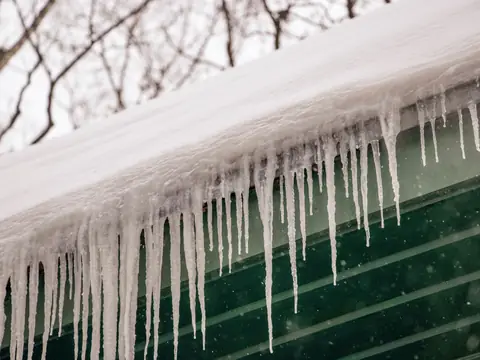
On a pitched roof, melting snow runs down to the edge, where the gutter is colder. If the gutter is already full of leaves or ice, the water freezes there and builds a ridge. The next melt runs into that ridge, has nowhere to go, and backs up under the bottom rows of shingles. From inside, it looks like a leak at the top of an outside wall or a window frame.
The simplest defense starts before the cold: clear the gutters and make sure the leaders are open at the bottom. Gutters and leaders are ordinary maintenance under New Jersey’s code, so replacing a sagging or broken gutter needs no permit. The gutters and flashing page has more.

Freeze and thaw at the seams
Water that gets into a small gap, under a lifted shingle, into a crack in flashing mortar or along a flat-roof seam, expands as it freezes and opens the gap a little more. Each round of freeze and thaw repeats it. A seam or a flashing joint that held all year can start to leak after a run of cold nights and mild afternoons.
Flat roofs under snow
On a rowhouse or walk-up with a flat roof, snow sits where it lands. When it melts, the water has to reach the drain or scupper, and if that is frozen or blocked, it stands on the roof and searches for an open seam. Snow drifting against the parapet can also keep the flashing there wet long after the storm. If you can see the roof safely from a window, look for water standing after a melt and tell the roofer where. The flat roof repair page covers ponding and drains.
What to do, and what not to do
- Keep off the roof and off ladders while there is ice or water on them
- Do not chip at ice in the gutters or on the roof; it can damage shingles, flashing and gutters
- Catch drips inside and move belongings away from them
- Photograph stains and damage for your insurer before cleaning up; whether a policy pays is the insurer’s decision
- Note where and when the water shows, and whether it comes with melting rather than with rain
- Call or send the form so a roofer can look at the roof edge, the gutters and the flashing together

Fixing it for good
A roofer looking at a melt-time leak checks the gutters and leaders, the roof edge, the underlayment at the eaves on a pitched roof, and the seams and flashing on a flat roof. The fix might be as simple as a cleared and re-hung gutter, or it might mean new flashing or a repair at the edge. For the wider picture, see roof leak repair and roof repair in Newark.
Getting ready before the cold
The easiest leak to deal with is the one that never starts, and most of the work is simple. Have the gutters and scuppers cleared once the leaves are down. Check that every leader is attached and runs freely. Look at the flashing around the chimney and at the parapet from a window or the hatch, and note anything loose. If a repair is due, ask for it while the roof is dry and the weather mild, when a roofer can do the job properly.
Questions people ask
Why does my roof leak when the snow melts but not when it rains?
Ice in the gutter or at the roof edge can dam meltwater and push it under the shingles. Rain runs off before it freezes, so the leak does not appear.
Should I knock ice off my gutters?
No. Chipping ice can damage gutters, shingles and flashing, and an icy ladder is dangerous. Ask a roofer to look once it is safe.
How much snow does Newark get?
An average of 31.5 inches a year at Newark Liberty in the 1991 to 2020 normals, mostly from December to March.
Get a Newark roofer
Get a Newark roofer on the roof
Send the details and an independent local roofer can contact you.
